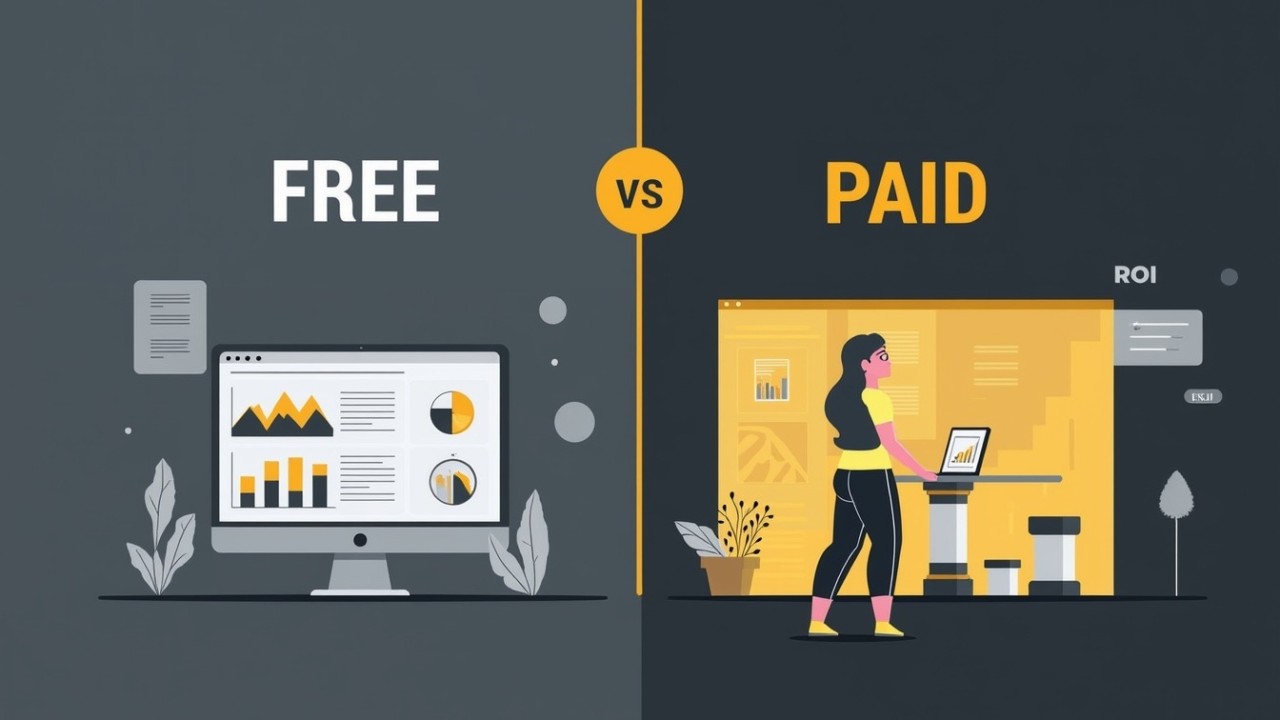
Let’s break down the real differences, the tradeoffs you’ll face, and how to make the right choice for your specific needs.
Understanding the Free AI Landscape
Free AI platforms aren’t just trial versions anymore. Many companies offer genuinely useful free tiers that can handle real work. Think of ChatGPT’s free version, Google’s Gemini, or Microsoft’s Copilot in limited forms.
What you typically get with free platforms:
You’ll usually access the company’s previous generation model or a scaled-down version of their latest technology. The tools work, they’re capable, and for many everyday tasks, they’re perfectly adequate. You can draft emails, brainstorm ideas, analyze basic data, and get quick answers to questions.
The hidden costs of “free”:
Here’s what most people don’t realize at first. Free platforms often come with usage limits that kick in when you need them most. You might hit a cap on messages per day, processing speed, or advanced features. During peak hours, you might experience slower response times as paid users get priority access.
Privacy is another consideration. Free platforms may use your data to improve their models (though policies vary by company). For sensitive business information, this could be a dealbreaker.
What You’re Actually Paying For
When you upgrade to a paid AI platform, you’re not just paying for bragging rights. Here’s what typically changes:
Access to more powerful models:
Paid subscriptions usually unlock the latest and most capable AI models. These aren’t just incrementally better, they can be significantly smarter at complex reasoning, more accurate with specialized tasks, and better at understanding nuanced requests.
Priority and speed:
During busy periods, paid users get pushed to the front of the line. Your requests process faster, and you won’t hit those frustrating rate limits that stop your workflow dead.
Enhanced features and integrations:
Many paid platforms include features that free versions don’t touch: longer conversation history, the ability to upload and analyze documents, image generation, advanced data analysis, API access, and integrations with your existing tools.
Better support and reliability:
Paid accounts often come with actual customer support, uptime guarantees, and more reliable service. When something breaks or you need help, you’re not just posting in a forum hoping someone responds.
The Real-World Tradeoffs
Let’s talk about what you’re actually giving up or gaining with each choice.
With free platforms, you trade:
- Flexibility for limitation: You work within strict boundaries on usage, features, and model access
- Consistency for uncertainty: Performance can vary based on server load and your priority in the queue
- Control for convenience: You accept the provider’s terms completely, including how they handle your data
- Advanced capabilities for basic functionality: You get solid, everyday features but miss out on cutting-edge capabilities
With paid platforms, you trade:
- Budget for capability: You’re spending money (anywhere from $20 to hundreds per month depending on the platform)
- Simplicity for complexity: More features mean more to learn and manage
- Casual use for commitment: You’re now invested, which changes how you think about using the tool
When Free Platforms Make Perfect Sense
Free doesn’t mean inferior for every use case. Here’s when sticking with free is actually the smart move:
You’re still exploring and learning:
If you’re just getting started with AI tools, free platforms let you experiment without financial commitment. You can figure out how AI fits into your workflow before investing.
Your needs are straightforward:
For simple tasks like drafting basic content, getting quick answers, or occasional brainstorming, free platforms handle these beautifully. Why pay for power you won’t use?
Volume isn’t critical:
If you’re only using AI a few times a week, you probably won’t hit the usage limits that make free platforms frustrating.
You’re working with non-sensitive information:
When data privacy isn’t a major concern, like working with public information or general knowledge tasks, free platforms pose minimal risk.
Budget constraints are real:
Sometimes free is the only option, and that’s okay. A free AI tool used well beats a paid tool sitting unused because you couldn’t justify the expense.
When Paid Platforms Become Essential
There are clear scenarios where paying for AI becomes not just worthwhile but necessary:
AI is central to your daily work:
If you’re using AI tools for hours every day, hitting rate limits becomes incredibly disruptive. The productivity gained from unlimited access pays for itself quickly.
You need consistent, high-quality output:
When you’re working on important client deliverables, detailed analysis, or complex problem-solving, you need the best model available. The quality difference between free and paid tiers becomes immediately obvious in high-stakes work.
Time is literally money:
Faster response times and priority access matter when you’re billing by the hour or working under tight deadlines. Waiting in queue on a free platform costs you more than the subscription would.
You’re handling sensitive information:
Business data, client information, strategic planning—these require platforms with enterprise-grade security, clear data policies, and compliance certifications that typically only come with paid plans.
You need team collaboration:
Most advanced team features, shared workspaces, and admin controls sit behind paywalls. If multiple people need access, paid platforms offer better management and security.
Integration is important:
Connecting AI to your other business tools, your CRM, project management software, or documentation platforms, usually requires paid API access or premium integrations.
Making the Decision: A Practical Framework
Instead of defaulting to free or assuming paid is always better, ask yourself these questions:
How often will you actually use it?
Calculate roughly how many times per week you’ll interact with the AI. If it’s daily or multiple times per day, lean toward paid. Weekly or less? Free might suffice.
What’s the cost of limitation?
Imagine hitting a usage limit during your busiest moment. What does that actually cost you in time, stress, and lost productivity? If that cost exceeds the subscription price, upgrade.
What’s your data sensitivity level?
Map out what information you’ll be inputting. If you’d be uncomfortable with that data potentially being used for training or stored indefinitely, prioritize paid platforms with stronger privacy guarantees.
Do you need the best, or is good enough actually good enough?
Be honest here. For many tasks, the difference between a good model and the best model won’t significantly impact your results. But for complex reasoning or specialized tasks, that gap widens considerably.
The Hybrid Approach
Here’s something many professionals don’t consider: you don’t have to choose just one.
Many successful professionals use a hybrid strategy. They maintain free accounts for quick, low-stakes tasks and casual use, while subscribing to one premium platform for their core, business-critical work.
For example, you might use a free platform for personal projects and general exploration, while paying for a premium platform that integrates with your work tools and handles your confidential business tasks.
This approach gives you flexibility without breaking the budget, and you’re not putting all your eggs in one AI basket.
Looking at Specific Costs
Let’s ground this in real numbers. Most major AI platforms charge between $20-30 per month for individual professional subscriptions. Enterprise or team plans scale up from there, sometimes into hundreds per month depending on usage and features.
Compare that to other professional tools you probably already pay for, your productivity software, cloud storage, or design tools. AI platforms at $20-30/month are relatively affordable for tools that can save hours of work weekly.
The question isn’t whether you can afford it, but whether the specific value it delivers to your work justifies the expense.
Common Mistakes to Avoid
Paying for features you’ll never use:
Don’t get seduced by long feature lists. Focus on what you’ll actually use weekly. If you’re paying for advanced API access but never write code, you’re wasting money.
Sticking with free when it’s costing you productivity:
Some professionals stubbornly stay on free tiers while spending hours working around limitations. Your time has value, sometimes upgrading is the economical choice.
Ignoring data policies:
Whether free or paid, actually read how the platform handles your data. This matters more than most people realize, especially for business use.
Not testing before committing:
Most paid platforms offer trials. Use them fully. Push the tools hard during the trial period to ensure they actually solve your problems before committing to a subscription.
The Bottom Line
- The free vs. paid decision isn’t about which is universally better, it’s about matching the tool to your specific situation.
- Free AI platforms have matured to the point where they’re genuinely useful for many professional tasks. If your needs are moderate, your usage is occasional, and your data isn’t sensitive, free might be all you need.
- Paid platforms make sense when AI becomes a core part of your workflow, when you need consistent high-quality output, when time and reliability matter, or when you’re handling sensitive business information.
The smartest approach? Start with free, identify your actual usage patterns and pain points, then upgrade strategically when you hit clear limitations that cost you more than the subscription would.
AI tools are meant to make your work easier and more efficient. Whichever path you choose, make sure it’s actually delivering that value, not just adding another subscription to your monthly bills or another limitation to work around.
Final Thoughts
We’re in a unique moment where genuinely powerful AI tools are available for free to anyone who wants to try them. That’s remarkable and worth taking advantage of.
But as these tools become more central to professional work, knowing when to invest in premium capabilities becomes a real competitive advantage. The businesses and professionals who figure this out, who know exactly when free is sufficient and when paid is essential, will work smarter and move faster than those who don’t.
The choice is yours. Just make sure it’s an informed one.