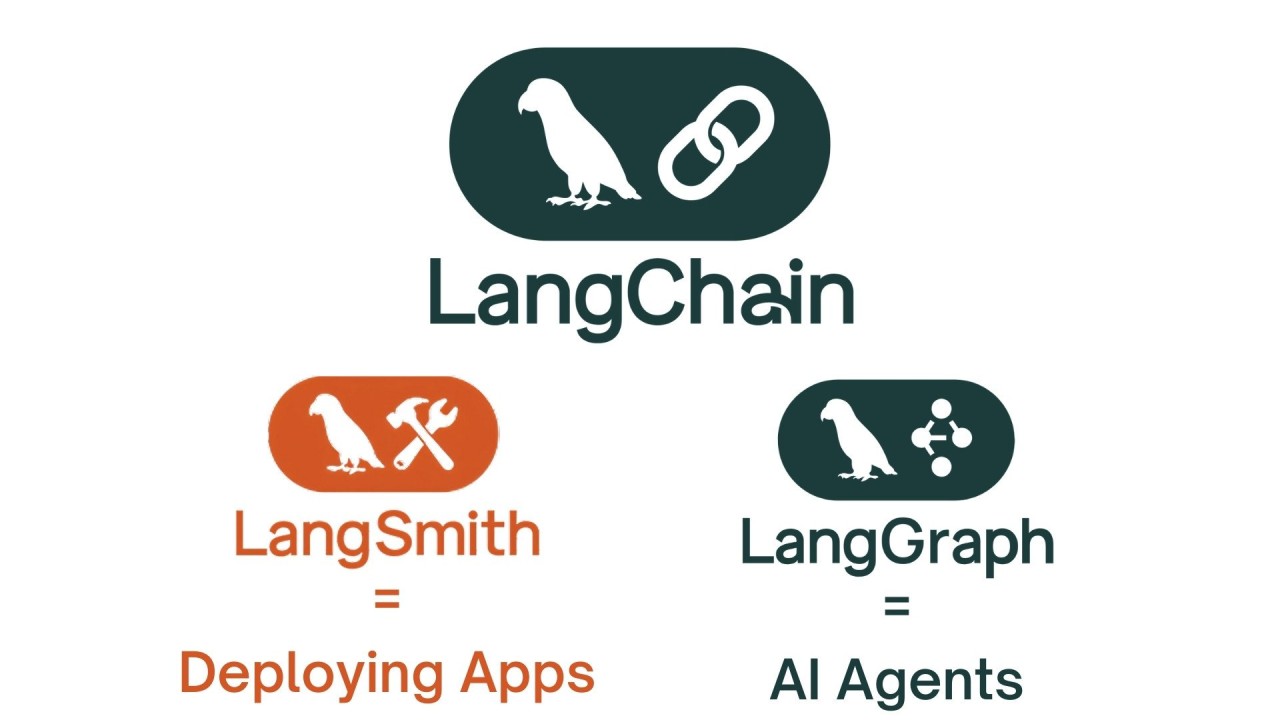
The rapid evolution of Large Language Models (LLMs) has transformed how developers build AI-powered applications. However, leveraging the full power of LLMs requires more than just API calls—it demands sophisticated frameworks for chaining, orchestrating, and monitoring complex workflows. In this detailed blog series, we explore three core components of the LangChain ecosystem: LangChain LangGraph, and LangSmith. Each tool addresses distinct challenges in building, managing, and optimizing LLM applications.
Part 1: LangChain – The Essential Framework for Building LLM Applications
What Is LangChain?
LangChain is the foundational open-source framework designed to simplify the development of applications powered by LLMs. It acts as a Swiss Army knife for AI developers by providing modular components to connect language models with external data, APIs, and tools, enabling the creation of intelligent, context-aware applications.
Core Features of LangChain
- Chains: Sequential workflows where each step processes input and passes output to the next, ideal for linear tasks like chatbots or document summarization.
- Agents: Autonomous decision-making entities that can choose tools or APIs dynamically based on user input.
- Prompt Templates: Structured prompt management for consistent and effective LLM querying.
- Memory: Context retention across interactions to enable conversational continuity.
- Integrations: Support for multiple LLM providers (OpenAI, Hugging Face, Anthropic, etc.) and tools for search, coding, databases, and more.
Why Use LangChain?
- Rapid Prototyping: Quickly build and test LLM applications with minimal boilerplate.
- Extensibility: Customize and extend workflows with your own tools and APIs.
- Community Support: A vibrant ecosystem with extensive documentation and examples.
Typical Use Cases
- Customer support chatbots that access company knowledge bases.
- Retrieval-augmented generation (RAG) systems combining search with LLMs.
- Automated content creation and summarization tools.
Part 2: LangGraph – Orchestrating Complex, Multi-Agent Workflows
What Is LangGraph?
LangGraph is an advanced framework built on top of LangChain that introduces graph-based orchestration for AI workflows. Unlike LangChain’s primarily linear chains, LangGraph supports complex, stateful graphs with loops, branches, and multi-agent collaboration.
Key Components of LangGraph
- Graph Nodes: Represent discrete operations such as LLM calls, API requests, or data transformations.
- Edges: Define data flow and control logic between nodes, enabling branching, retries, and loops.
- State Management: A centralized, persistent state store accessible by all nodes, allowing memory and context to be shared across the workflow.
- Multi-Agent Support: Multiple agents can communicate and collaborate, passing information dynamically to solve complex tasks.
Why Choose LangGraph?
- Complex Workflow Handling: Perfect for applications requiring conditional logic, error handling, and iterative processes.
- Stateful Applications: Maintains context and memory across long-running interactions.
- Multi-Agent Collaboration: Enables sophisticated AI systems where different agents specialize and coordinate.
Use Cases Ideal for LangGraph
- Virtual assistants managing multi-step, context-dependent conversations.
- AI systems that require review-and-approve flows or multi-agent decision-making.
- Complex data synthesis pipelines aggregating information from diverse sources.
Part 3: LangSmith – Observability, Debugging, and Optimization Platform
What Is LangSmith?
LangSmith is the monitoring, debugging, and evaluation platform designed to complement LangChain and LangGraph. It provides developers with the tools to trace, test, and optimize their LLM-powered applications in production.
Features of LangSmith
- Real-Time Logging: Capture detailed logs of every step in your workflow, including inputs, outputs, and errors.
- Performance Monitoring: Track model response times, success rates, and other key metrics.
- Evaluation and A/B Testing: Compare different prompt strategies or model versions to identify the best performing configurations.
- User Interface: A clean dashboard to visualize workflows, inspect runs, and debug issues interactively.
- Seamless Integration: Works natively with LangChain and LangGraph workflows.
Why LangSmith Matters
- Production Readiness: Ensures your AI applications run reliably and efficiently at scale.
- Continuous Improvement: Enables data-driven refinement of prompts, chains, and agents.
- Error Diagnosis: Quickly identify and fix issues in complex multi-agent workflows.
Common Use Cases
- Monitoring chatbot interactions to maintain quality and compliance.
- Evaluating new LLM models or prompt designs before deployment.
- Debugging multi-step workflows with complex branching and retries.
Comparative Overview: LangChain vs. LangGraph vs. LangSmith
| Aspect | LangChain | LangGraph | LangSmith |
| Primary Focus | Linear chaining of LLM calls and tools | Graph-based orchestration with loops & state | Monitoring, debugging, and evaluation |
| Workflow Style | Sequential, reactive | Complex, stateful, multi-agent collaboration | Observability and performance tracking |
| State Management | Limited, mostly per interaction | Centralized, persistent state across nodes | Tracks state and logs for debugging |
| Use Cases | Chatbots, RAG, summarization | Virtual assistants, multi-agent workflows | Production monitoring, A/B testing |
| Integration | Supports many LLMs and APIs | Same as LangChain, plus graph orchestration | Integrates with LangChain and LangGraph |
| Scalability | Suitable for small to enterprise projects | Handles large-scale, complex workflows | Scalable monitoring across projects |
Final Thoughts
Together, LangChain, LangGraph, and LangSmith form a powerful ecosystem for building, orchestrating, and maintaining sophisticated LLM applications:
- Start with LangChain for straightforward, linear AI workflows.
- Move to LangGraph when your applications require complex logic, state management, and multi-agent collaboration.
- Use LangSmith to gain deep visibility into your AI systems, enabling continuous monitoring, debugging, and optimization.
This trio empowers developers to build AI applications that are not only intelligent but also robust, maintainable, and production-ready. For those eager to dive deeper, check out https://academy.finxter.com/langchain-langsmith-and-langgraph/ this guide to learn how to harness these tools effectively. Let Sinjun handle the technology so you can concentrate on what matters most—growing your business.. Contact us today for a consultation and discover how Sinjun can support your business’s evolution.