What happens to your customers’ private data every time your AI model learns from it?
Most business leaders never ask this question and that is exactly the problem. Every time your machine learning model trains on customer records, health data, financial transactions, or behavioral patterns, there is a real risk that private information gets exposed. It could leak through a cyberattack. It could get pulled out by a clever hacker. It could even get reconstructed by someone who studies your AI model’s outputs long enough. The scary part is that this happens even when you think the data is “anonymous.”
The good news is there are proven, real-world techniques that let your business use AI and machine learning without putting your customers’ private data at risk. Two of the most powerful ones are Differential Privacy and Federated Learning. Big names. Simple ideas. And by the end of this article, you will know exactly what they mean, how they work, and when your business should use them.
Why Business Data Privacy Is a Bigger Problem Than You Think
Before we get into the solutions, let’s talk about why this is urgent right now. The market for privacy-enhancing technologies is growing from $3.12 billion in 2024 to $12.09 billion by 2030, which tells you that businesses across every industry are waking up to the fact that protecting data is no longer optional. In the European Union, the AI Act came into effect in February 2025, with specific provisions addressing AI privacy, and in the United States, the regulatory landscape is tightening fast. Four states implemented new privacy laws effective January 1, 2025, with New Jersey following on January 15th.
Beyond regulations, the financial risk is real. Data breaches cost businesses millions not just in fines, but in lost customer trust, damaged reputation, and legal battles that drag on for years. Data breaches and privacy violations extract a heavy toll on organizations, with lost business, diminished reputation, and regulatory fines adding up to millions in costs.
The three biggest risks businesses face with standard ML models are:
- Re-identification attacks: Someone strips out the names from your dataset, but a researcher can still figure out who each person is using just three pieces of information. Latanya Sweeney proved that 87% of Americans could be identified based on only three metrics ZIP code, date of birth, and sex.
- Gradient leakage: Even when you don’t share raw data, the updates your AI model sends out can accidentally reveal sensitive information about the people it learned from.
- Regulatory penalties: Privacy laws are getting stricter every year, and non-compliance is becoming more expensive than ever before.
This is exactly where privacy-preserving machine learning comes in.
What Is Privacy-Preserving Machine Learning?
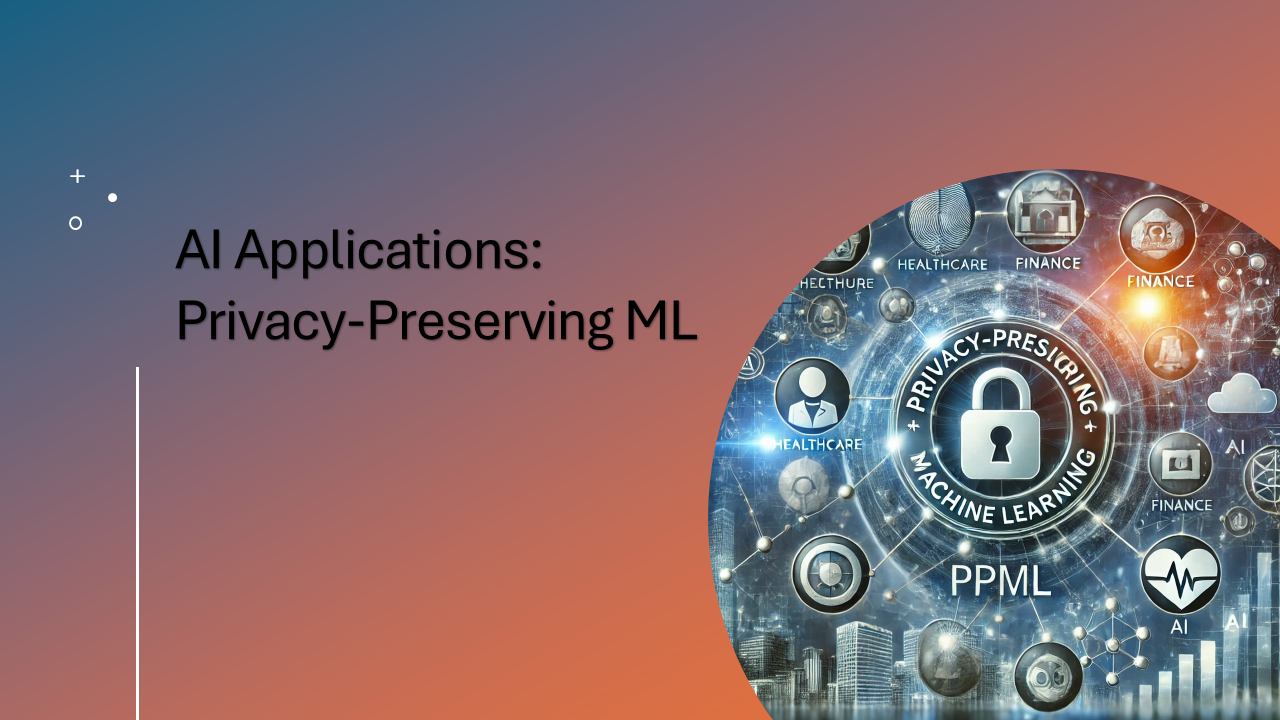
Privacy-preserving machine learning is a collection of techniques that allow AI models to learn from data and deliver real business insights without exposing the private details of individual people in that dataset. Think of it like a two-way mirror. The AI can see the patterns in the data. But no one looking at the AI’s output can see back through and identify a specific person.
Core methods include differential privacy, homomorphic encryption, secure multi-party computation, and federated learning, with hybrid approaches combining multiple methods providing the strongest privacy guarantees. This article focuses on the two techniques that are most practical and immediately useful for businesses today: Differential Privacy and Federated Learning.
Technique 1 – Differential Privacy
What It Is in Plain Language
Imagine you run a survey asking your employees whether they are happy at work. You want to report the results, but you don’t want to expose any person’s answer. Differential privacy works by injecting carefully calibrated noise into statistical computations such that the utility of the statistic is preserved while provably limiting what can be inferred about any individual in the dataset.
The “noise” here is not random chaos. It is a very precise, mathematically calculated amount of randomness that protects individual privacy while keeping the overall insight accurate and useful. Differential privacy is a mathematical approach for anonymizing data that provides quantifiable privacy guarantees it works by carefully adding noise to datasets to prevent leaking individual information.
Think of it like this. Imagine your business has 10,000 customer records. Differential privacy adds just enough mathematical “blur” to protect any single customer’s data, while the overall patterns like spending trends, preferences, or risk scores remain clear for your AI to learn from.
How It Works – Step by Step
Here is the simple version of how differential privacy works inside a business system:
- Your data goes into the system: Customer records, transaction data, health information, whatever your AI needs to train on
- The system adds controlled noise: A mathematical algorithm introduces a precise amount of randomness to the data before any analysis happens
- The AI learns from the noisy version: The model sees patterns in the group, not details about individuals
- Results come out protected: The insights are accurate enough to be useful, but no one can reverse-engineer which specific person contributed which data point
There are two main approaches for implementing differential privacy. The first is local differential privacy, where noise is added to individual data points before they are aggregated. The second is global differential privacy, where noise is added after raw data is collected from individuals into a dataset. Local differential privacy offers stronger privacy protection since noise additions happen right at the source, but global differential privacy is generally easier to implement and analyze.
The Privacy Budget – What You Need to Know
There is one important concept in differential privacy that every business leader should understand, and that is the privacy budget, also called epsilon (ε). Epsilon controls how much noise is introduced to the dataset; it quantifies the privacy budget, meaning how much privacy loss is acceptable. Higher epsilon means more noise and more privacy protection, while lower epsilon leads to more accurate but less private data.
In simple terms, the privacy budget is like a spending limit. Every time your system runs a query on the data, it “spends” a little of that budget. Once the budget is used up, you cannot run more queries without risking privacy. This is why planning your data analysis strategy matters a lot when using differential privacy.
Real Businesses Already Using Differential Privacy
This is not a future technology. It is already running inside systems you use every day.
- Apple uses differential privacy to learn how you use your keyboard and emoji on your iPhone, without Apple ever seeing what you specifically type
- Google uses it to collect browser statistics from Chrome users while protecting individual browsing patterns
- LinkedIn used differential privacy to publish labor market insights showing which employers were hiring the most, without exposing which specific users changed jobs
- The US Census Bureau adopted differential privacy for the 2020 Decennial Census to protect sensitive information in published statistics
- AWS launched Clean Rooms Differential Privacy, allowing businesses to analyze shared datasets including for advertising and insurance while protecting individual users
Companies can quantify their level of safety because differential privacy uses mathematical formulas while other methods of security can only make claims about how private a dataset is, differential privacy can back up those claims with mathematics, which is a huge legal advantage as privacy laws evolve.
When Should Your Business Use Differential Privacy?
Differential privacy is the right choice when:
- You want to publish or share aggregate reports from sensitive data like customer surveys, health statistics, or financial trends without revealing individual records
- You need to comply with privacy regulations like GDPR, HIPAA, or the new US state laws, and you want a mathematically provable privacy guarantee
- You are training AI models on customer data and need to ensure that individual customers cannot be identified from the model’s outputs
- You want to collaborate with partners by sharing data insights without giving them access to your raw customer database
Differential privacy is not the best choice when you need to analyze very small datasets, because adding noise to a small dataset can make the results too inaccurate to be useful. For small datasets, the noise introduced can disproportionately degrade utility performance improves with larger sample sizes.
Technique 2 – Federated Learning
What It Is in Plain Language
Federated learning solves a different version of the same problem. Instead of asking “how do we protect individual data points inside one dataset?”, it asks: “What if we never moved the data at all?”
Federated learning enables collaborative model training without centralizing raw data. Here is what that looks like in practice. Imagine five hospitals that each have thousands of patient records. They all want to train an AI model that can detect early signs of cancer. Under the old approach, they would have to send all their patient data to one central server, which creates massive privacy risks and regulatory headaches. With federated learning, each hospital trains the AI model locally on their own data. The model learns what it needs to learn. Then only the model’s updated parameters not the raw patient records, get sent to a central server, where they are combined into one smarter, more accurate global model.
The patients’ private data never leaves the hospital. The model gets better. Everyone wins.
How It Works – Step by Step
Here is exactly how federated learning runs in a real business system:
- A central server creates a starting model: Think of it as a blank AI that does not know anything yet
- The model is sent to each participant: Each hospital, branch, device, or company receives a copy of this starting model
- Each participant trains locally: The model learns from local data that never moves or gets shared
- Only model updates get sent back: Instead of sending raw data, each participant sends the model’s updated weights and parameters to the central server
- The server combines everything: It aggregates all the updates into one improved global model
- The cycle repeats: The improved model goes back out, learns more, and keeps getting better all without anyone’s private data ever leaving its original location
In this architecture, local devices first train their models using their own private data. These locally trained models specifically, their updated weights, are then sent to a central server. The server aggregates these weights, for example by using a weighted average, to create a new improved global model. This updated global model is then broadcast back to the devices and the cycle repeats. This iterative process preserves data privacy, as the raw data never leaves the local device, while collaboratively improving the global model’s performance.
Real Businesses Already Using Federated Learning
Federated learning is already delivering measurable results across multiple industries.
- Healthcare: In January 2025, Owkin launched K1.0 Turbigo, an advanced operating system for drug discovery using AI and multimodal patient data from its federated network. Multiple hospitals are also using federated learning to build cancer diagnosis models across hospital networks without sharing patient records.
- Financial Services: In December 2024, Google Cloud partnered with Swift to develop privacy-preserving AI model training for financial institutions. A major bank used federated learning to fine-tune its loan default prediction algorithm using data from a global telecommunications company, resulting in approximately 10% improvement in prediction accuracy.
- Insurance: Zurich Insurance collaborated with Orange Telecom using a commercial platform to train algorithms on Orange’s data without Orange releasing any information, and the collaboration led to a 30% improvement in AI predictions, translating to significant revenue increases.
- Mobile AI: Google uses federated learning to improve autocomplete and keyboard suggestions on Android phones. Your phone learns locally, shares only the model update, and Google’s keyboard gets smarter without ever seeing your messages.
Approximately 67% of organizations across healthcare, finance, and technology sectors are already piloting or implementing federated learning strategies which means if your business is not exploring this yet, your competitors probably are.
When Should Your Business Use Federated Learning?
Federated learning is the right choice when:
- Your data is spread across multiple locations different offices, partner organizations, devices, or hospitals and moving it all to one place is not practical or legal
- Your industry has strict data localization laws meaning certain data legally cannot leave the country or facility where it was created
- You want to collaborate with other companies on building shared AI models without sharing your raw data with them
- Your data involves very sensitive categories like health records, financial transactions, or personal communications where centralized storage creates unacceptable risk
- You are building AI for edge devices like smartphones, IoT sensors, or industrial equipment, where sending data to the cloud is slow, expensive, or risky
The One Limitation to Know About Federated Learning
Federated learning is not a complete privacy solution on its own. Federated learning offers a decentralized alternative to centralized training, however it remains vulnerable to information leakage through gradient sharing. This is why the most effective implementations combine federated learning with differential privacy adding mathematical noise protection to the model updates before they get sent to the central server. When these two techniques work together, the privacy protection is significantly stronger than either one alone.
Differential Privacy vs. Federated Learning – Which One Do You Need?
Here is a simple comparison to help you decide which approach fits your situation.
| What You Need | Best Technique |
| Protect individual records inside one large dataset | Differential Privacy |
| Train AI across multiple locations without moving data | Federated Learning |
| Share data insights with partners safely | Differential Privacy |
| Comply with data localization laws | Federated Learning |
| Run analytics on sensitive aggregate data | Differential Privacy |
| Build AI on mobile devices or IoT sensors | Federated Learning |
| Prove mathematically that privacy is protected | Differential Privacy |
| Collaborate across hospitals, banks, or branches | Federated Learning |
| Maximum protection for extremely sensitive data | Both Combined |
The cleanest answer for most businesses dealing with truly sensitive data is to use both together. Federated learning makes sure the raw data never moves. Differential privacy makes sure even the model updates that do move cannot be reverse-engineered to reveal individual information.
How to Know If Your Business Is Ready for These Techniques
Not every business needs to implement these immediately. Here is a quick self-assessment to figure out where you stand right now.
Signs You Need Differential Privacy Now
- You are collecting and analyzing customer data at scale and publishing results
- You have received or are worried about regulatory fines related to data privacy
- You share data insights with advertising or marketing partners
- Your AI models train on health, financial, or personally identifiable information
- You want to be able to prove your privacy practices in court or to regulators with mathematical evidence
Signs You Need Federated Learning Now
- Your data lives in multiple physical locations that you cannot or should not centralize
- You want to build a shared AI model with partner organizations without a data-sharing agreement
- You operate in healthcare, finance, or another regulated industry where data localization is required
- Your AI needs to learn from data on mobile apps, wearables, or IoT devices
- You have had conversations about data sharing partnerships that fell apart because of privacy concerns
The Practical Steps to Get Started
Getting started with privacy-preserving ML does not require a team of PhD researchers. Here is a realistic path forward for most businesses.
Step 1 – Audit Your Data Risk
Before choosing a technique, understand where your greatest privacy risk lives. Ask your data team: What sensitive data are we currently using to train AI models? Where does that data live? Who can access it? What happens if it gets exposed?
Step 2 – Identify the Right Technique
Use the comparison table above to figure out whether differential privacy, federated learning, or a combination of both fits your situation. When in doubt, talk to a privacy-focused AI consultant who can assess your specific setup.
Step 3 – Start With Available Tools
You do not need to build these systems from scratch. Enterprise platforms are already emerging – Microsoft launched its Confidential AI platform in 2024 for privacy-preserving machine learning, and IBM acquired privacy startup Inpher to strengthen its confidential computing capabilities. Open-source options also exist, including PySyft for federated learning and Google’s TensorFlow Privacy library for differential privacy.
Step 4 – Run a Pilot on One Use Case
Pick one specific problem – maybe it is your customer analytics model, or a fraud detection system that pulls from multiple branches. Run a pilot using the right privacy technique. Measure the accuracy of the model. Compare it against the business risk of not protecting that data. Let the numbers guide your decision to expand.
Step 5 – Build Privacy Into Every New AI Project
The biggest shift is cultural. Privacy-preserving techniques work best when they are built in from day one not added as an afterthought. Make it a standard requirement that every new AI project answers the question: “How are we protecting the individuals in this data?” before the project moves forward.
What Happens If You Ignore This
Let’s be direct about the risk of doing nothing. Privacy regulations are not getting softer – they are getting stricter every single year. Privacy-preserving AI provides a technical foundation for compliance across jurisdictions by minimizing data collection and ensuring that sensitive information is protected throughout the AI lifecycle. Businesses that wait for a breach or a regulatory fine to motivate action will pay a much higher price in money, in reputation, and in customer trust – than businesses that build these protections in proactively.
The businesses building AI responsibly right now are the ones that will be trusted with more customer data, more partnerships, and more market share over the next decade. Privacy is not a tax on innovation. It is a competitive advantage.
A Quick Summary – Everything in One Place
Here is the full picture in plain language before you move on.
- Differential Privacy: adds mathematical noise to your data so that AI can learn from group patterns without exposing any individual’s private information it works best for analytics, model training, and data sharing
- Federated Learning: keeps data exactly where it is and only shares model updates it works best when your data is spread across multiple locations, devices, or partner organizations
- Both together: are the strongest approach for businesses handling truly sensitive data like health records, financial information, or private communications
- The regulatory pressure is real: privacy laws tightened significantly in 2024 and 2025, and the trend is not reversing
- Real tools already exist: you do not need to build anything from scratch to start protecting your business and your customers today
Ready to Build AI That Is Both Powerful and Private?
You now understand the techniques, the business cases, and the risk of doing nothing. The next step is finding the right partner to help you implement this in a way that fits your specific industry, data environment, and business goals.
Sinjun AI helps businesses design, build, and deploy AI solutions that are powerful, compliant, and built with privacy at the core, not as an afterthought. Whether you are just starting to think about privacy-preserving AI or you are ready to move your existing ML systems toward a safer architecture, Sinjun AI gives you the expertise and the roadmap to do it right the first time.